



Today, Artificial Intelligence is everywhere. However, whenever we talk about AI, our conversation mostly revolves around ChatGPT, Gemini, Claude, Perplexity, and others, mainly the software side. We rarely talk about the physical “body” required to run that “brain.”
The reality is that software cannot exist without hardware. For AI to write that professional-looking email, generate cool image, or even drive a physical car, there are physical chips that have to do the heavy lifting.
AI Hardware is essentially computer hardware designed to execute machine learning algorithms and neural networks. These chips are built to handle the massive mathematical workload required to run AI much faster and more efficiently compared to standard computer parts.
That’s why in this guide, I will break down everything about AI Hardware, including specific chips used for AI, the difference between “learning” and “doing,” and why this matters for the laptop or phone you might buy next.
Why Can’t a Normal CPU Do It?
Before we talk about special AI chips, it’s important to understand how a standard computer processor (CPU) works compared to an AI processor:
- CPU (Central Processing Unit): This is the main brain of our computer. It runs the operating system, manages files, and handles almost everything on our system. However, its biggest limitation is that it solves every problem one by one. This is called “Serial Processing.”
- AI Chips (GPU or NPU): These are capable of processing multiple math operations at once. This is called “Parallel Processing.”
The reason the CPU cannot manage AI models is that AI does not rely on doing one complex logic puzzle at a time. It does billions of tiny math problems, called matrix multiplication, all at once to generate a single word, code, or pixel. To run AI efficiently, we have to rely on chips that can handle Parallel Processing.
AI Chips (Key Terminology)
These days, whenever we read spec sheets of newly launched computers or read tech news, there are some common terms used. Here’s what these acronyms mean:
- GPU (Graphics Processing Unit): These chips were originally designed to render graphics for video games. However, it turned out that the math required to render 3D graphics is almost identical to the math required to run AI.
- NPU (Neural Processing Unit): These are relatively new chips and have become the new standard for consumer electronics devices like smartphones and laptops. This chip is specifically designed to run AI tasks efficiently. Yes, an NPU is not as powerful as a GPU, but it can run AI features without instantly draining your battery.
- TPU (Tensor Processing Unit): This is Google’s custom silicon used in its data centers to power its services and in Pixel devices to handle Google-specific tasks.
- LPU (Language Processing Unit): These are Groq’s specialized processors designed for data center inference of large language models. They handle tokenization, attention mechanisms, sequence modeling, and context efficiently.
- HBM (High Bandwidth Memory): This is a type of RAM that allows the processor to access huge AI files quickly.
The Two Worlds of AI Hardware: Training vs. Inference
This is the most important distinction to understand in the AI industry.
| Feature | Training | Inference |
| What it is | The process of teaching the AI model by feeding it massive amounts of data. | The process of using the trained AI to solve new problems or answer questions. |
| Where it happens | Massive Cloud Data Centers & Supercomputers. | Your Device (Laptop, Phone, Watch) or the Edge. |
| Hardware Used | High-end GPUs (e.g., Nvidia H100) and TPUs linked together. | Consumer NPUs, efficient GPUs, or CPUs. |
| Power Consumption | Extremely high; requires massive cooling and energy. | Low; designed to preserve battery life. |
| Goal | To create “Intelligence” (a model). | To apply that intelligence instantly. |
Types of Consumer AI Hardware
Here are the AI devices that you can buy today, which don’t look like they came straight out of a sci-fi movie:
- AI PCs: These days, many premium laptops meet the Copilot+ standard with NPU performance of 40+ TOPS (Trillions of Operations Per Second), enabling local tasks like summarization and image editing.
- AI Smartphones: Today, all smartphones come with AI features. Modern smartphones, especially the flagship ones, are capable enough to perform live language translation during a phone call or “Magic Eraser” photo editing right on the phone.
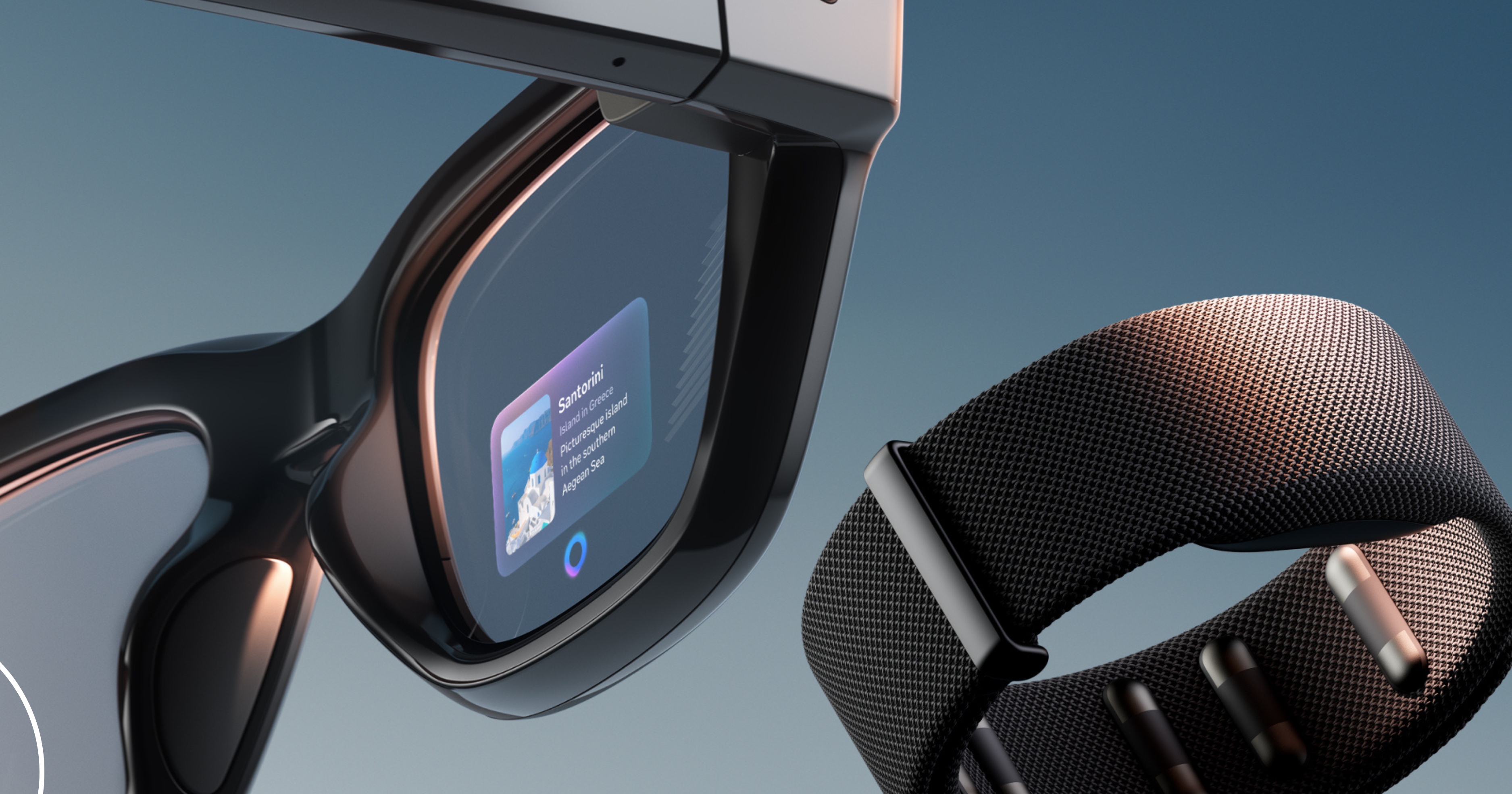
- AI Wearables: While this category is still emerging, the hottest devices are smart glasses, like the Ray-Ban Meta glasses that come with cameras and microphones to understand the world around you.
Why Do You Need AI Hardware?
Now, the question that might come to anyone’s mind is: since I can use ChatGPT or Gemini on almost any device, why would I need a special chip on my phone or laptop? There are four main reasons:
- Privacy: This is one of the biggest reasons. When you use an AI platform like ChatGPT in a browser, your data is sent to a company’s servers. But when tasks like image editing or face unlocking run on an NPU, the AI works locally. This means your data never leaves the device.
- Speed (Latency): Using an AI platform involves the cloud, which means you need a stable internet connection with good speed to perform well. However, on-device hardware allows the AI to give instant results.
- Offline Capability: If your hardware is powerful enough, you can use AI assistants, summarization tools, and translators even when you are on an airplane or have no Wi-Fi.
- Cost: Running AI in the cloud is expensive for companies. Eventually, companies may charge high subscription fees for cloud access, while local AI on your own chip is free to use after you buy the device.
The Future of AI Hardware
We are still in the early stages of AI hardware, and engineers are working on three big shifts:
- Neuromorphic Computing: These are chips designed to physically mimic the structure of the human brain, using artificial “synapses” and “neurons” rather than standard logic gates.
- Photonics: Current chips use electricity to move data. Photonic chips use light (lasers). This could technically allow data to move at the speed of light with almost zero heat generation.
- Energy Efficiency: The biggest problem with AI right now is energy consumption. The race is on to create chips that can deliver high intelligence using a fraction of the power required today.
We are currently at a stage where hardware is both the bottleneck and the enabler of the AI revolution. Software developers have ambitious ideas, but they are limited by how fast and efficient chips can be.
For most non-technical users, AI today means chatbots. But developers are pushing far beyond that. As newer and more efficient chips arrive, we will move away from simple browser-based chatbots toward proactive AI assistants that live on our devices, understand personal context, and work instantly and privately.
We already saw glimpses of this future at the recently concluded Consumer Electronics Show (CES) 2026, where AI laptops and smart glasses were among the biggest highlights. NVIDIA, the largest supplier of GPUs for AI, has also announced a stronger focus on AI-specific chips going forward. All of this points to one clear direction: in the coming years, we will see a wave of new AI hardware devices entering the market.