



A new report from Counterpoint Research warns that smartphone prices could increase in 2026 as the cost of memory components rises.
According to Counterpoint’s latest analysis, prices of key memory components used in smartphones have surged massively in early 2026. DRAM prices increased by more than 50% quarter-over-quarter in Q1 2026, while NAND Flash prices jumped by over 90% during the same period.
Entry-Level Smartphones Hit the Hardest
The report highlights that entry-level smartphones are seeing the most severe impact.
For devices priced below $200, a common memory configuration of 6GB LPDDR4X RAM and 128GB eMMC storage could push total BoM costs up by more than 25% quarter-over-quarter in Q1 2026. Memory alone is expected to account for about 43% of the total BoM for such devices.
Mid-Range Phones Also Facing Rising Component Costs
The mid-range segment, typically priced between $400 and $600, is also seeing increasing cost pressure.
For a configuration with 8GB LPDDR5X RAM and 256GB UFS 4.0 storage, the BoM share of memory is expected to rise significantly:
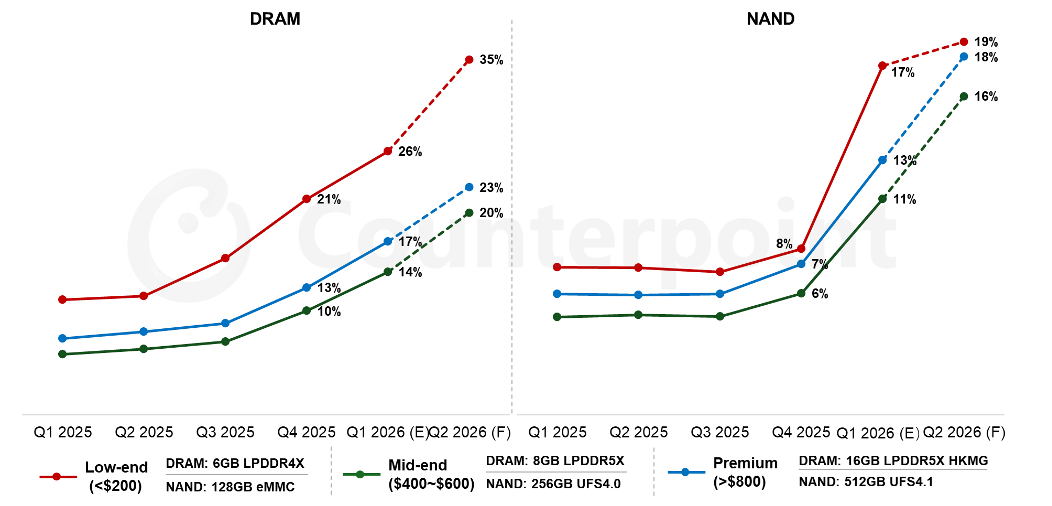
- DRAM share: around 14% in Q1 2026, increasing to 20% by Q2 2026
- NAND share: around 11% in Q1 2026, rising to 16% by Q2 2026
Flagship Phones Could Become Even More Expensive
Premium smartphones priced above $800 are expected to face dual cost pressures from both memory components and next-generation processors built on 2nm fabrication nodes.
For flagship devices using 16GB LPDDR5X memory and 512GB UFS 4.1 storage, the BoM cost could increase by $100 to $150 by Q2 2026, according to the report.
By that time, DRAM and NAND could account for roughly 23% and 18% of the total BoM, respectively.
OEMs May Simplify Specs and Reduce Entry-Level Models
Senior Analyst, Shenghao Bai said the increase in memory prices is creating a structural shift in smartphone cost structures.
According to Bai, manufacturers will struggle to balance component costs, profit margins, and shipment targets in 2026.
To manage the situation, smartphone brands are expected to take several measures:
- Streamlining product portfolios by reducing shipments of low-end models
- Optimizing hardware specifications, including downgrading non-core components to offset rising costs
Retail Price Hikes Likely in 2026
Counterpoint believes cost-cutting alone will not be enough to absorb the surge in memory prices. As a result, retail price increases appear likely in 2026. The firm expects:
- Entry-level smartphones to become about $30 more expensive
- Premium flagship devices to see price increases of $150 to $200
Memory Price Surge Triggers Shi…
If these projections hold, customers can see noticeable price hikes across multiple smartphone categories next year, especially as memory remains one of the most expensive components inside modern devices.