



Today, AI is everywhere and running an AI model locally on your PC is no longer limited to researchers or BTech companies. It’s 2026 and thanks to powerful hardware, open source models and user-friendly tools. Almost anyone can run AI models directly on their machines. Running an AI model locally comes with bunch of benefits with its data privacy, latency API cost or more.
That’s why in this GuideI will be talking about how to run AI models locally. The article covers everything from hardware to software tools, models, and more.
How to Run AI Models Locally: Step-by-Step Guide 2026
Follow the steps mentioned below to run AI models on your own hardware:
- Install Ollama (Easiest for Beginners): Download from ollama.com for Windows, macOS, or Linux. Run the installer, open a terminal, and enter ollama run llama3.1, it auto-downloads Meta’s Llama 3.1 (8B) model and starts a chat interface. Generate text instantly; no coding needed.
- Add a Web UI (Optional, User-Friendly): Install Open WebUI via Docker (docker run -d -p 3000:8080 –add-host=host.docker.internal:host-gateway -v ollama:/root/.ollama -v open-webui:/app/backend/data –name open-webui –restart always ghcr.io/open-webui/open-webui:main). Access at http://localhost:3000, connect to Ollama, and chat via browser.
- Try LM Studio for Model Exploration: Download from lmstudio.ai. Search Hugging Face models (e.g., Mistral Nemo 12B Q4), download quantized versions to save VRAM, load, and test prompts. Monitor speed in tokens/second aim for 30+ on RTX 4070.
- Advanced Setup with Hugging Face: Install Python 3.10+ and run pip install transformers torch bitsandbytes accelerate.
- Optimize and Test: Use nvidia-smi to check GPU usage. For speed, enable flash attention (–flash-attn). Run offline prompts like coding or summarization to verify.
This setup handles 7B-13B models smoothly on mid-range hardware, scaling to 70B with 24GB VRAM.
Local AI vs Cloud-Based AI
As the name says, local AI runs models on your PC or servers, keeping everything offline. On the other hand, cloud AI processes via remote servers. Running AI locally gives complete control and needs no subscriptions, though you have to invest in hardware first. Whereas cloud scales easily but charges per use and risks data leaks.
| Aspect | Local AI | Cloud AI |
| Cost | One-time hardware | Ongoing API fees |
| Privacy | Data stays local | Sent to provider |
| Latency | Milliseconds | 100ms+ network delay |
| Offline | Works anywhere | Needs internet |
Why Run AI Models Locally?
Running AI locally on your own hardware empowers developers, creators and businesses with speed and independence without compromising on privacy. Plus in the long run, it cut costs. Here are some of the primary reasons to run AI models locally:
Data Privacy and Security
When you run AI locally, your data stays on your device. Chats, documents, and code nothing is sent to external servers. This removes the risk of data leaks or third-party surveillance. Local AI also makes it easier to comply with regulations like GDPR and HIPAA without extra effort.
Offline Accessibility and Reliability
Local AI works even without the internet. You can use it on flights, in remote locations, or during power or network outages. There’s no dependency on cloud uptime or API availability.
Avoiding API Costs and Rate Limits
Cloud AI comes with recurring costs and usage limits. For heavy users, these expenses add up quickly. Local models remove this problem entirely. Once set up, you can run unlimited queries at no extra cost.
Low Latency Performance
Local AI is faster because there’s no network delay. Responses often come in milliseconds instead of waiting on cloud servers.
Hardware Requirements for Running Local AI
Local AI is a “VRAM-first” game. While a fast CPU helps, the GPU is the real engine.
The Importance of VRAM (Video RAM)
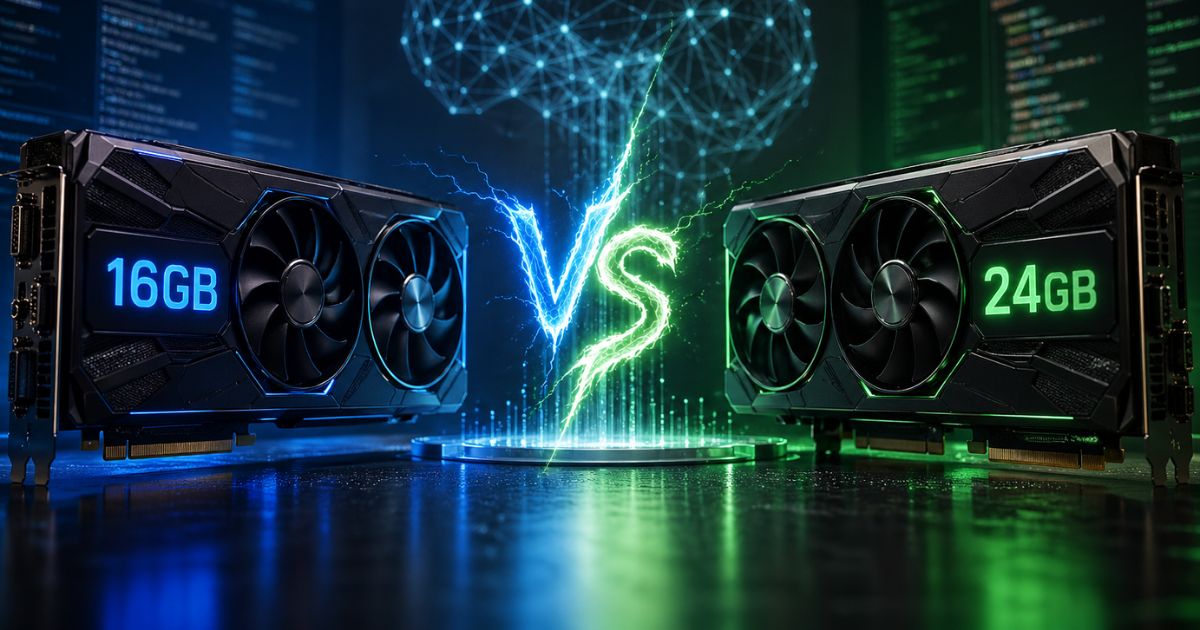
VRAM is where the model “lives” while it’s thinking. If a model file is 8GB and you only have 6GB of VRAM, the model will “spill over” into your system RAM, making it painfully slow. In 2026, 24GB of VRAM (found in cards like the RTX 3090/4090/5090) is considered the “sweet spot” for high-end local AI.
GPU vs. CPU: Which Should You Use?
- GPU (Recommended): Thousands of small cores designed for the math (matrix multiplication) that AI uses.
- CPU: Can run AI using specialized libraries (like llama.cpp), but expect speeds of 2–5 tokens per second compared to 50+ on a GPU.
- Unified Memory (Apple Silicon): Mac M3/M4 chips are unique because the GPU can use the entire system RAM as VRAM. A Mac Studio with 128GB of RAM can run massive models that would otherwise require $20,000 enterprise GPUs.
Recommended RAM for 7B, 13B, and 70B Models
Most models are “quantized” (compressed) to fit on consumer hardware.
- 7B – 8B Models: 8GB VRAM (Minimum), 16GB System RAM.
- 13B – 14B Models: 12GB VRAM (Minimum), 32GB System RAM.
- 70B+ Models: 48GB+ VRAM (or Apple Unified Memory), 64GB+ System RAM.
Storage Speed: NVMe vs. SATA SSDs
AI models are massive files (from 5GB to over 100GB). Using an NVMe M.2 SSD is essential for loading these models quickly. A SATA SSD or traditional HDD will make the initial loading phase take minutes instead of seconds.
Software and Tools Needed to Run AI Models Locally
Operating System Compatibility
- Linux: The home of AI. Offers the best performance and easiest driver management (Ubuntu is the standard).
- Windows: Excellent thanks to WSL2 (Windows Subsystem for Linux) and native support from Ollama/LM Studio.
- macOS: High-performance “out of the box” for M-series chips.
Python and Package Managers
If you are a developer, you’ll need Python 3.10+. Use Conda or Poetry to manage your environments to avoid “dependency hell” where different AI tools clash with one another.
AI Frameworks and Libraries
- PyTorch: The underlying framework most models are built on.
- llama.cpp: The magic library that allows LLMs to run on consumer hardware and CPUs.
- Hugging Face Transformers: The industry-standard library for downloading and interacting with models.
Popular AI Models You Can Run Locally
- Llama 3.1 (8B/70B): Versatile chat/coding
- Mistral Nemo (12B): Fast, multilingual
- Phi-3 Mini (3.8B): Runs on 4GB VRAM, great for laptops
- Gemma 2 (9B): Google’s efficient coder
- Qwen 2.5 (7B): Strong in math/reasoning
Common Challenges When Running AI Models Locally
- Hardware Limitations: The biggest hurdle is the “VRAM Wall.” If you don’t have enough, you simply can’t run the largest, smartest models.
- High Memory Usage: Running a local LLM can hog your system resources. If you are trying to run a 70B model and edit 4K video at the same time, your system will likely crash or crawl.
- Slow Inference Speeds: On older hardware, you might see “one word per second” speeds. This is usually due to poor quantization choices or slow memory bandwidth.
- Compatibility Issues: Mismatched CUDA versions (for NVIDIA users) or lack of ROCm support (for AMD users) can lead to frustrating setup errors. Ollama solves most of this by bundling dependencies together.
Is Running AI Models Locally Worth It?
Yes, absolutely. In 2026, the gap between cloud AI and local AI has narrowed. While the “frontier” models like GPT-5 still hold an edge in massive-scale reasoning, local models are now “good enough” for 90% of daily tasks. The combination of total privacy, zero latency, and no monthly fees makes local AI a must-have for the modern power user.
FAQs
Yes, using CPU-only setups like llama.cpp. Speeds are slower (5-10 tokens/second), best for small 1-7B models on 16GB+ RAM.
– 7B models: 6-8GB (Q4 quantized)
– 13B: 10-12GB
– 70B: 24-40GB. Start with 8GB for most tasks.
Open-source local models like Llama 3.1 match or beat GPT-3.5 level; slightly behind top proprietary like GPT-4o, but quantization minimally impacts quality.