



These days the craze around AI platforms like ChatGPT, Gemini, or Perplexity is immense. All these AI softwares have become a part of our daily life. But it’s the hardware behind these AI platforms that runs these AI platforms.
In this article, AI hardware means the physical systems that run AI workloads. This includes chips, PCs, smartphones, wearables, robots, servers, and the factories that build them.
The companies below are selected based on three factors: real-world adoption, technical innovation, and long-term impact on how AI is deployed, from the cloud to personal devices.
The Chipmakers
The Big Three
1. NVIDIA
- HQ: Santa Clara, CA
- Why it matters: NVIDIA is the undisputed king of AI. Their graphics processing units (GPUs) are currently the only chips powerful enough to train massive models like GPT-5.2 quickly. Without them, the modern AI industry would likely not exist.
- Key Product: Blackwell B200 GPU.
2. AMD
- HQ: Santa Clara, CA
- Why it matters: AMD is the primary challenger to NVIDIA. Large tech companies are buying AMD chips to avoid relying on a single supplier. They offer a strong alternative for high-performance computing at a potentially lower cost.
- Key Product: Instinct MI300 Series.
3. Intel
- HQ: Santa Clara, CA
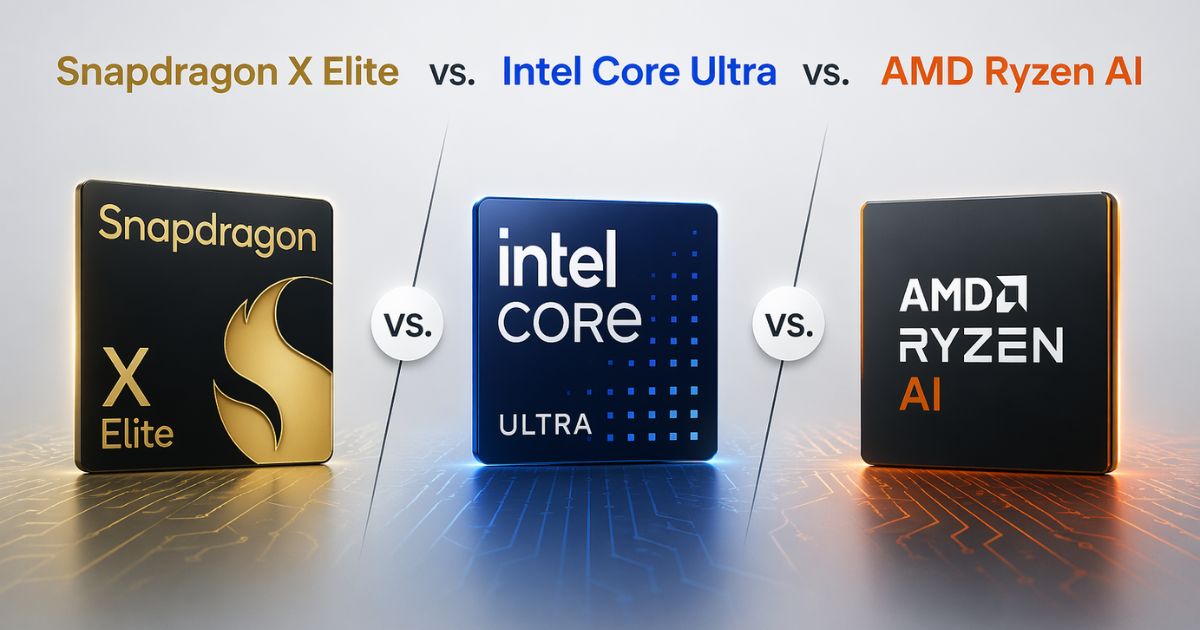
- Why it matters: Intel leads AI PCs with built-in NPUs. Core Ultra chips run 40+ TOPS for local AI, and its Gaudi accelerators compete in training.
- Key Product: Core Ultra (Lunar Lake) and Gaudi 3.
Mobile & Edge Silicon
4. Qualcomm
- HQ: San Diego, CA
- Why it matters: Known for powering Android phones, Qualcomm is now dominating the “AI Laptop” space. Their chips are proving that Windows laptops can have all-day battery life and powerful on-device AI capabilities.
- Key Product: Snapdragon X Elite.
5. Apple
- HQ: Cupertino, CA
- Why it matters: Apple doesn’t sell chips to others, but their “Apple Silicon” is industry-leading. They integrated “Neural Engines” into their chips years before it was a trend, allowing iPhones and Macs to run AI tasks locally and privately.
- Key Product: M-Series (M5) and A-Series chips.
6. MediaTek
- HQ: Hsinchu, Taiwan
- Why it matters: MediaTek powers the majority of budget and mid-range smartphones globally. By adding AI processing to affordable chips, they are democratizing access to AI features for billions of people.
- Key Product: Dimensity 9400.
7. Arm
- HQ: Cambridge, UK
- Why it matters: Arm doesn’t manufacture chips; they design the architecture (the blueprints). Almost every smartphone chip and many new AI server chips are built on Arm’s efficient designs.
- Key Product: Neoverse CSS (Compute Subsystems).
The AI PC Leaders (Laptops and Desktops)
8. ASUS
- HQ: Taipei, Taiwan
- Why it matters: ASUS was one of the first to market with the new wave of AI laptops. They serve the creator and gamer markets, which need the most power for local AI image generation and video editing.
- Key Product: Vivobook S 15.
9. Acer
- HQ: New Taipei City, Taiwan
- Why it matters: Acer focuses on accessibility. They are bringing AI capabilities to lower price points, so that students and casual users can access the latest AI features.
- Key Product: Swift 14 AI.
10. Lenovo
- HQ: Beijing, China / Morrisville, NC
- Why it matters: As the world’s largest PC maker, Lenovo’s adoption of AI hardware drives the entire market. They are integrating AI chips across their massive ThinkPad and Yoga lineups.
- Key Product: ThinkPad T14s Gen 6.
11. HP
- HQ: Palo Alto, CA
- Why it matters: HP is rebranding its consumer lines around AI, with the “OmniBook” series. They are focusing on “AI Companion” software that optimizes the PC’s performance based on what you are doing.
- Key Product: OmniBook X AI.
12. Dell
- HQ: Round Rock, TX
- Why it matters: Dell is focusing heavily on enterprise AI. They are building workstations that allow companies to run private AI models on their own desks, ensuring sensitive corporate data never leaves the building.
- Key Product: Dell Precision AI Workstations.
AI Smartphones
13. Samsung
- HQ: Suwon, South Korea
- Why it matters: Samsung launched the “Galaxy AI” on its smartphones, and started integrating features like “Circle to Search” and live call translation.
- Key Product: Galaxy S25 Series.
14. Google
- HQ: Mountain View, CA
- Why it matters: Google builds its own “Tensor” chips specifically to run Google AI. This allows Pixel phones to have exclusive features like “Magic Editor” for photos and the smartest voice recorder in the industry.
- Key Product: Pixel 10 Series.
Specialized AI Chips
15. Groq
- HQ: Mountain View, CA
- Why it matters: Groq focuses on speed. Their Language Processing Unit (LPU) is designed for “inference” (running the model), making chatbots reply instantly rather than waiting for the text to generate word by word.
- Key Product: Groq LPU.
16. Cerebras
- HQ: Sunnyvale, CA
- Why it matters: Instead of making small chips, Cerebras makes the largest chip in the world, the size of a dinner plate. This allows them to keep all data on one chip, which removes the slow communication between multiple smaller chips.
- Key Product: Wafer-Scale Engine 3 (WSE-3).
17. SambaNova
- HQ: Palo Alto, CA
- Why it matters: SambaNova sells a complete platform including hardware and software. Their “Dataflow” architecture is built to handle models that traditional chips struggle to move around efficiently.
- Key Product: SN40L Processor.
18. Tenstorrent
- HQ: Santa Clara, CA
- Why it matters: Led by legendary chip architect Jim Keller, Tenstorrent uses RISC-V (an open-standard architecture). They license their designs to other companies, allowing anyone to build their own custom AI chips cheaply.
- Key Product: Wormhole / Blackhole chips.
19. Etched
- HQ: San Francisco, CA
- Why it matters: Etched is taking a huge risk by building a chip that does only one thing: run Transformer models.
- Key Product: Sohu.
AI Wearables and Next-Gen Form Factors
20. Meta
- HQ: Menlo Park, CA
- Why it matters: Their smart glasses are the most successful AI wearable so far. They allow users to look at an object and ask an AI assistant questions about it, blending fashion with multimodal AI.
- Key Product: Ray-Ban Meta Smart Glasses.
21. Brilliant Labs
- HQ: Singapore
- Why it matters: They produce open-source AI glasses. Their “Frame” glasses look like standard eyewear but have a tiny display and camera, allowing developers to write their own AI apps for the real world.
- Key Product: Frame.
22. Oura
- HQ: Oulu, Finland
- Why it matters: Oura uses AI to analyze biological signals like sleep, heart rate, and stress. They are moving from simple tracking to AI coaching, which tells you why you are tired and how to fix it.
- Key Product: Oura Ring 4.
23. Ultrahuman
- HQ: Bengaluru, India
- Why it matters: It’s the biggest competitor to Oura, they aggregate data from their ring and glucose monitors. Their AI correlates your food intake with your sleep quality to give metabolic insights.
- Key Product: Ring Air.
Embodied AI (Robotics and Physical World)
24. Tesla
- HQ: Austin, TX
- Why it matters: Tesla is arguably the biggest robotics company. Their self-driving cars are essentially robots, and they are applying that same visual learning technology to their humanoid robot, Optimus, designed to replace factory labor.
- Key Product: Optimus (Gen 2) / FSD Hardware 4.
25. Boston Dynamics
- HQ: Waltham, MA
- Why it matters: Famous for viral robot videos, they recently retired their hydraulic robots for fully electric ones. This makes them quieter, stronger, and more suitable for real-world commercial work alongside AI brains.
- Key Product: Electric Atlas.
26. Figure AI
- HQ: Sunnyvale, CA
- Why it matters: Figure partnered with OpenAI to give their robots speech and reasoning capabilities. Their robots are already being tested on BMW manufacturing lines.
- Key Product: Figure 02.
27. Sanctuary AI
- HQ: Vancouver, Canada
- Why it matters: They focus on “human-like intelligence.” Their robots are trained by human pilots wearing VR rigs, allowing the AI to learn complex hand movements by watching humans do them first.
- Key Product: Phoenix.
28. Skydio
- HQ: San Mateo, CA
- Why it matters: Skydio makes drones that fly themselves. Unlike standard drones that follow GPS, Skydio uses AI computer vision to see obstacles and dodge them in real-time, widely used by the military and inspectors.
- Key Product: Skydio X10.
Manufacturing and Infrastructure
29. TSMC
- HQ: Hsinchu, Taiwan
- Why it matters: TSMC is the most important company in the global AI supply chain. They are the only manufacturer capable of reliably producing the advanced chips designed by NVIDIA, Apple, and AMD.
- Key Product: 3nm and CoWoS Packaging tech.
30. ASML
- HQ: Veldhoven, Netherlands
- Why it matters: ASML makes the lithography machines that print chips. They have a monopoly on Extreme Ultraviolet (EUV) machines. Without ASML, TSMC cannot make chips, and NVIDIA cannot sell GPUs.
- Key Product: High-NA EUV Systems.
31. Supermicro
- HQ: San Jose, CA
- Why it matters: They build the physical server racks that hold the AI chips. Their modular design allows data centers to plug in new liquid-cooled AI systems faster than competitors.
- Key Product: H100/H200 GPU SuperServers.
32. Broadcom
- HQ: Palo Alto, CA
- Why it matters: AI clusters need thousands of chips to talk to each other. Broadcom builds the specialized networking switches and custom silicon that prevent traffic jams in these massive supercomputers.
- Key Product: Jericho3-AI / Tomahawk 5.
33. SK Hynix
- HQ: Icheon, South Korea
- Why it matters: They dominate the market for High Bandwidth Memory (HBM). This is a special type of fast memory that sits right next to the NVIDIA GPU.
- Key Product: HBM3E Memory.
So right now, we are going through an interesting transition, where the first phase of AI was centered around data centers and trained AI models, and the second phase is about on-device AI. The focus is shifting to phones, laptops, and wearables that can run these models locally. The winners of the next decade are likely to be the ones who can make AI hardware faster, cheaper, and energy-efficient enough to run anywhere, not just in a server farm.