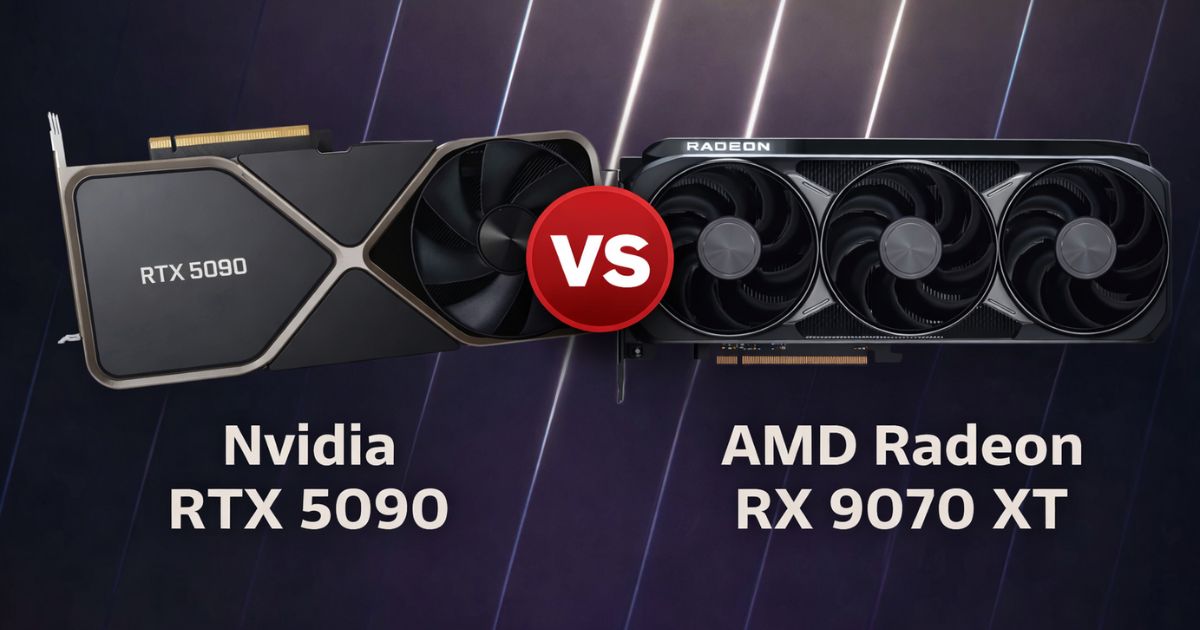




Today, AI is everywhere. But the majority of people are focusing on the latest AI models, and almost no one is talking about the hardware beneath them. Whether it’s smartphones, laptops, data centers, or smart glasses, AI chips power the entire AI ecosystem.
That’s why in this listicle i have compiled some of the leading AI chip companies that you should know about if you are an AI enthusiast. Though do keep in mind that i have not ranked these companies in any manner, and it simply explains what each company does in the AI hardware world.
1. NVIDIA
Everyone knows about NVIDIA. It is the largest GPU company, creating GPUs and AI accelerators that handle many AI training and inference tasks.
NVIDIA’s hardware is common in data centers, research labs, and more AI-focused systems across different industries. For many advanced AI tasks, NVIDIA chips are still the go-to option.
2. AMD
AMD makes CPUs and GPUs that run AI tasks on PCs, servers, and in data centers. Recently, AMD has worked to boost AI performance along with general computing. Which make its chips useful for both everyday devices along with the large AI systems.
3. Intel
Intel creates CPUs, GPUs, and special AI accelerators that can handle AI tasks. The company focuses on AI across laptops, enterprise systems, and data centers. However, the primary aim of the company is to integrate AI into mainstream computing rather than treating it as a separate workload.
4. Qualcomm
Qualcomm needs no introduction. It designs system-on-chip (SoC) solutions with dedicated AI engines for smartphones and edge devices.
These chips are made for on-device AI tasks like camera processing and voice recognition. They are also designed to save power, which makes Qualcomm important in mobile AI hardware.
5. Apple
Apple creates its own chips with built-in Neural Engines for iPhones, iPads, and Macs. Where AI components handle tasks like image processing, face recognition, and system intelligence directly on the device, with a focus on efficiency and privacy.
6. Google
Google makes its own AI chips to power its AI services and cloud systems, and it mainly focuses on accelerating machine learning workloads, especially for large-scale AI models used across Google products.
7. Amazon
Amazon also creates its own AI chips for its cloud platform to manage training and inference tasks. These chips help Amazon scale its AI services and depend less on outside hardware.
8. Samsung Electronics
Samsung makes AI-ready chips and memory for smartphones, consumer devices, and servers. The company has an advantage, as it designs processors and supplies important memory components for AI systems too.
9. MediaTek
MediaTek is the second player when it comes to smartphone chips. It creates AI-enabled chips for smartphones, smart TVs, and IoT devices. The company focuses on providing efficient AI performance, especially in mid-range and affordable devices.
10. Huawei
Huawei makes AI chips for infrastructure, data centers, and edge uses. Despite having market restrictions, the company continues to develop AI hardware for internal and regional use cases.
11. Broadcom
Broadcom creates custom chips and networking hardware that help move AI data. Broadcom plays an important role in helping large AI systems communicate efficiently in data centers.
12. TSMC
TSMC does not design AI chips, but it makes most of the world’s advanced AI. Almost every major AI chip company relies on TSMC’s manufacturing technology.
13. Micron Technology
Micron produces memory and storage used in AI systems. High-bandwidth memory is essential for AI performance, making Micron a key enabler rather than a direct chip designer.
14. SK hynix
SK hynix provides memory solutions that are optimized for AI tasks. Its products are used in AI servers and accelerators, where fast data access is just as important as processing power.
15. IBM
IBM develops processors that are optimized for AI in business and research systems. The company focuses on combining AI acceleration with reliability and long-term enterprise use cases.
16. NXP Semiconductors
NXP designs chips for edge AI applications such as automotive systems and industrial devices. Its hardware is built for real-time processing where low latency and reliability are important.
17. STMicroelectronics
STMicroelectronics develops microcontrollers and processors with built-in AI capabilities. These chips are used in edge devices where power efficiency and local AI processing matter.
18. Imagination Technologies
Imagination designs GPU and AI-related intellectual property used by other chipmakers. Its technology often appears inside mobile and embedded processors.
19. Graphcore
Graphcore makes AI accelerators that are designed for machine learning tasks. The company targets specialized AI use cases rather than general-purpose computing.
20. Cerebras Systems
Cerebras creates wafer-scale AI processors made for very large AI models. Its approach is all about high performance when training large neural networks.
21. Groq
Groq builds AI processors designed for fast and predictable inference. The company emphasizes low latency and efficiency over raw flexibility.
22. Arm
Last but not least is the Arm who designs processor architectures used in smartphones, laptops, and embedded devices. Today majority of the AI chips rely on Arm-based designs, which makes it a foundational player in the AI hardware space.
That’s all for now. But this one list makes one thing clear “there is no single company that controls the AI hardware space.” Some focus on cloud AI, others on on-device intelligence, and many work behind the scenes so that our AI models run smoothly.